Using Inspera Originality to build Integrity and Trust

Good tools do not punish. They teach. It’s time we treated academic integrity as a core part of learner development.
Yes, you can use Inspera Originality (IO) for plagiarism and AI prediction. Inspera Originality, powered by Pangram, is 99.9% accurate for AI prediction, with a 100x lower false positive rate than other industry tools, all while being backed by third party sources. If the sole purpose of your approach is prediction, then Inspera Originality is the tool of choice. But, what if you could do more?
Inspera Originality evolves beyond the traditional approach by serving as an academic support tool that promotes integrity by offering meaningful context-aware feedback throughout the entire learning journey. Students can submit their work, view their Inspera Originality report, and use the feedback contained within to improve their writing, their referencing, and their academic writing.
Building academic integrity in students should not put them at odds with the educators who are trying to help and support them. Integrity is not an innate trait but a learned skill. If we build integrity checks into the discussion from the start, instead of just an end-of-process punitive model, we can transform uses of academic integrity tools from compliance checks to tools used for academic mentorship.

The building blocks of integrity.
Inspera Originality offers the following functionality:
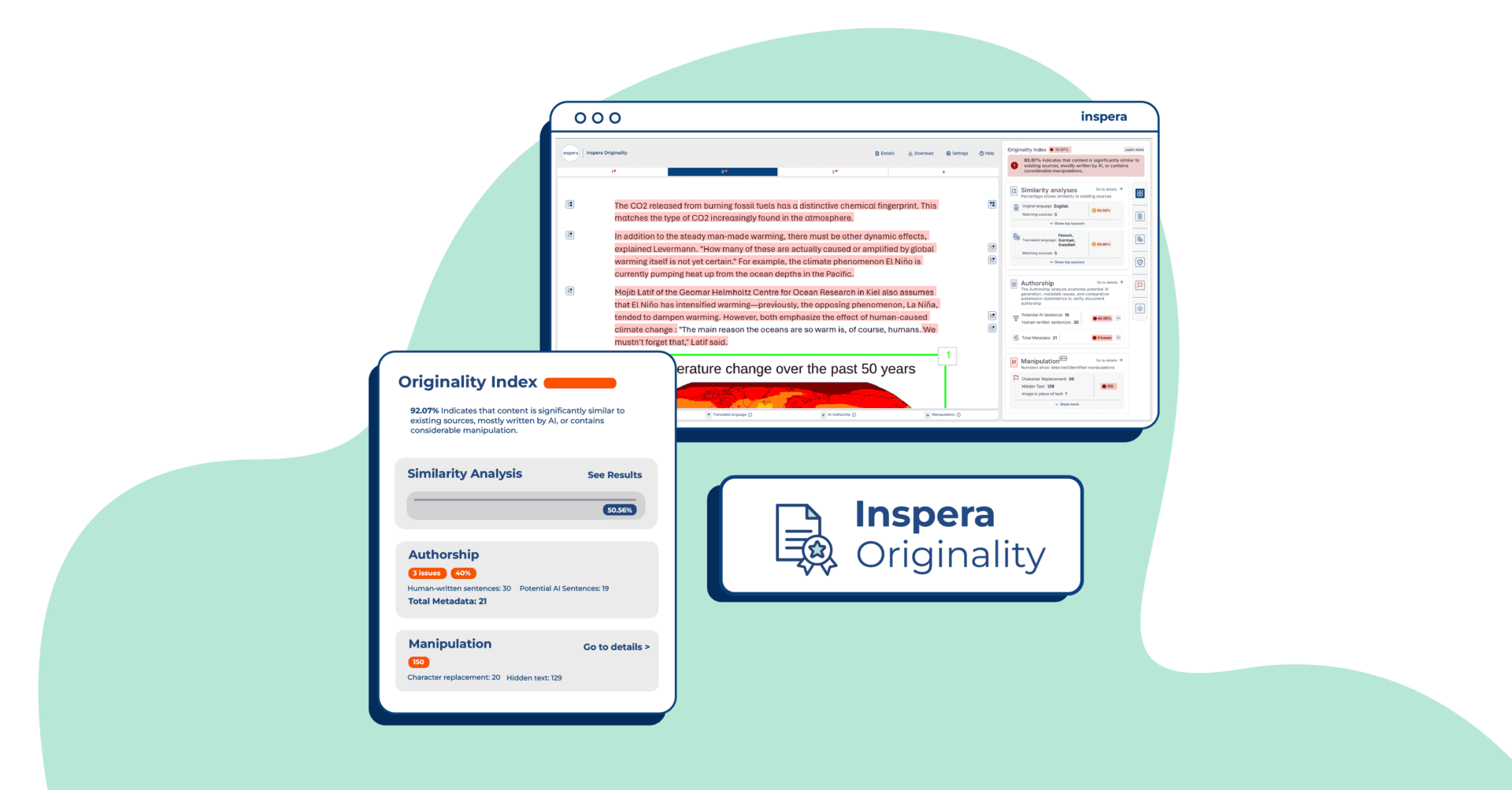
- IO offers advanced authorship analytics. AI prediction, similarity checking, translation similarity, text manipulation and metadata analysis providing context and multi-dimensional insights for decisions on academic integrity.
- IO brings pedagogical intelligence for holistic learning outcomes. Reports can help educators guide students on citation, paraphrasing and academic writing development. This enhances professional expertise with meaningful evidence, not a replacement for academic judgement.
- Promotion of authentic voice development in students. Transparency and trust can be enhanced through pre-submission checks available only to the student.
A workflow that promotes integrity and trust.
For the purposes of this article, we’ll show how the learning journey can be kickstarted through the process of submitting a dissertation-style essay. Students usually attend some form of seminar or tutorial where they can discuss their work prior to submission. We’ll demonstrate how IO can be integrated into these sessions, provided an originality report is shared before each one, to guide conversations between the educator and student.
Educators might want to position these meetings as a workshop that promotes academic writing and originality, rather than a plagiarism check; the discussion now shifts to one which is conducive to learning.
Understanding the Student Starting Point
Students tend to use AI to generate large chunks of text when they get ‘blank page anxiety’ and don’t know where to start. In this format, AI becomes a sounding board for ideas. This can be a very healthy way for students to use AI, if managed correctly, and serves as a good example of how AI can support student learning. Using examples like this, and others mentioned below, begins to show students acceptable AI use in an academic setting.
What’s critical is that students understand that AI can facilitate their learning but not culminate as the output of their work.
It’s easy to give the feedback: “Your AI score is high. You’ve clearly used AI to write this for you.”
However, if a student is using AI to write, that speaks to a wider issue.
Instead, highlight the weaknesses in AI writing so that students can both improve their understanding and know the weaknesses of the tool they are using. For example: “This section reads as a bit formulaic and descriptive, it lacks your critical perspective. AI tools are great for brainstorming. How about we feed the question into {AI MODEL} and prompt it to brainstorm three points for our essay. Let’s then look at fleshing these out and adding your individual flair to the essay.”
This instantly meets the student at their current experience level, and provides constructive feedback.
Delivering an Integrity Development Session:
The core idea of this session will be to showcase the submission process with an AI enhanced document, and an entirely human document. Both will be entered into Inspera Originality, and from there, a constructive critique can take place.
Outcomes:
- Students understand the strengths and weaknesses of AI writing.
- Students understand the strengths and weaknesses of human writing.
- Students can think critically about their work regardless of their starting point.
- Students can identify the strengths of both styles and incorporate them into their work.
- Students can open up a meaningful and transparent dialogue with their educator.
- The IO software remains a facilitator for these discussions, used correctly, it provides a handy tool to inform academic judgement, not a definitive answer. IO is built for today’s educational realities focusing on authentic outcomes rather than just percentages or reports.
The key is to make understanding the strengths and weaknesses of both approaches a key part of the learner journey. For example, academics can show generative texts and critique them by asking “What new ideas does this text bring?” and “what makes this text stand out?” Generative text is often repetitive and derivative, so showcasing this and allowing students to critique the work is an excellent way to highlight ways that they can improve upon the AI generated text.
Conversely, an academic can show the submission written entirely by a human and critique the flow, the structure, and the way the submission delivers its ideas. A strength of AI, when it is used correctly, is the ability for the AI supported text to communicate clearly, concisely and directly. When framed this way, the conversation then shifts to students seeing AI as a way of improving their work, not creating it entirely.
Equally, feedback that encourages AI use can look something like this: “I can see you’re trying to use this source, but your own ideas are not quite shining through from the original. How would you go about explaining this paragraph to a friend over lunch? What does it actually mean?” If the student is struggling to articulate the idea, they can converse with generative AI to test various prose styles.
They can then read through and underline each part of the response, highlight wherever the AI response is lacking, or the system has misinterpreted what’s being asked in the question.
Set the Boundaries Clearly:
This session is not encouraging students to use generative AI to write their assignments for them. If large chunks of a student’s essay are exact matches for other texts, or large chunks are flagged as written by AI, it’s likely that a student has surrendered sovereignty of their paper to sources. Instead of original argument or explanation, they are using others’ work as too much of a crutch.
Feedback Example: “You’ve gathered some great evidence here, but it feels like a playlist of someone else’s songs. I’d like you to 1. synthesise what is going on. 2. Get yourself in the discussion, what would you add/ refine to these ideas to bring them into your own argument?”
Once again, students can incorporate AI support into helping them articulate their ideas, without losing their unique viewpoint.
The Benefit for International Students
This approach is particularly pertinent for international students writing in English as a second language. There is occasionally a tendency for them to feel as though their ‘academic’ English writing doesn’t fit into the cookie cutter mould that is expected of them. At the same time, the fear of being overly flagged by AI detection leaves international students in a nebulous space of needing support, but being afraid to use the tools available to them. This AI supported approach to learning ensures that these students understand the boundaries, and can use these tools for learning, without sacrificing their unique ideas.
It’s time to build Trust
When software acts as a facilitator for critical thinking and transparent mentorship, we stop punishing the learning process and start cultivating genuine academic growth. The future of assessment lies in building trust, boundaries, and confidence.