Marking rarely begins and ends with reading a submission and awarding a grade.
Academics read and interpret student work, apply assessment criteria, make judgements and turn those judgements into useful feedback. Where several markers are involved, the process may also require moderation. Depending on the assessment, academics may use originality reports as part of their approach to academic integrity. Each element plays an important role in making assessment fair, consistent and meaningful for students.
Academics need the time and support to maintain these standards across large volumes of marking. This can be difficult when large cohorts and growing assessment volumes add to already demanding workloads. Students also expect timely, useful feedback, while institutions must uphold academic integrity and consistency.
The challenge is not simply to grade faster. It is to create grading and feedback workflows that are efficient, transparent and scalable, while maintaining academic quality and keeping human judgement with the educator.
To do this, institutions need to examine the practical steps surrounding marking and identify where unnecessary work or repetition can be reduced.

How can institutions make marking more efficient at scale?
A marker comes across a conceptual misunderstanding in a student’s response. They identify the problem, consider how best to explain it and write useful feedback.
A few scripts later, the same misunderstanding appears again.
The new response still needs to be read and considered properly. But does the marker need to write the same explanation from scratch?
Across a handful of scripts, that repetition may not seem significant. Across a large cohort, the time involved quickly adds up.
Making well-considered, educator-written feedback easier to find and reuse can reduce duplicated effort. The marker can adapt an existing comment when the student’s response calls for something different, rather than beginning with an empty text box every time.
Educators still decide whether each comment is appropriate for the work they are assessing. The benefit comes from reducing repeated activity, not reducing the academic consideration given to each submission.
This is why institutions are reviewing how marking workflows are designed: not simply to process submissions more quickly, but to reduce unnecessary work while giving academics more scope to provide useful, considered feedback.
Why should grades, criteria and feedback be connected?
Students need to see a clear connection between their grade, the assessment criteria and the feedback they receive.
They receive a mark and want to understand how it was reached:
Why did my work receive this grade? What did I do well? Where did I fall short? What should I concentrate on next time?
Good feedback helps answer those questions.
When grades, assessment criteria and feedback sit in different parts of the marking process, academics must work harder to maintain the relationship between them. Students may also find it harder to see how the comments they receive relate to their grade.
Bringing these elements together makes the reasoning behind the grade clearer.
This is particularly important when several people are marking the same assessment. Shared rubrics give the team a common frame of reference, while a central feedback resource allows markers to build on explanations that have already been carefully developed rather than writing new responses each time.
This is not about making every marker sound the same or giving students identical comments when their responses contain a similar issue.
Students produce work with different strengths, weaknesses and nuances, so markers still need to exercise academic judgement. A shared approach provides a consistent foundation and reduces unwarranted variation in the student experience.
A mark communicates the outcome. Feedback should help students understand it and show them how they can improve.
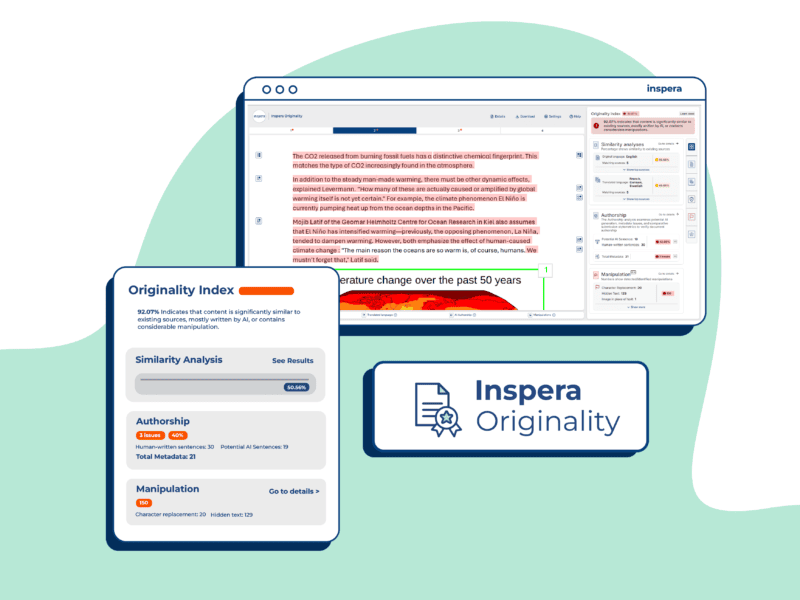
How can originality reporting fit into the marking workflow?
Originality reporting can sometimes sit separately from the rest of the marking process.
A report can provide useful evidence, but its findings still require interpretation. It cannot determine an outcome on its own. The educator understands the assignment, the discipline and the circumstances surrounding the student’s submission.
Making that evidence available alongside the submission, assessment criteria and feedback can reduce switching between separate tools and give academics a clearer view of the information relevant to their decision – in one place.
How can Classification AI support marking without replacing academic judgement?
The phrase “AI marking” can hide an important distinction.
Generative AI creates new content, whereas classification AI recognises and categorises patterns using examples provided to it.
In marking, classification AI can learn from decisions already made for a particular question and suggest relevant feedback or a rubric level when similar responses appear.
The marker remains responsible for reviewing each suggestion and making the final decision. Used in this way, classification AI can reduce repetitive activity without transferring academic judgement to the technology.
What should institutions look for in a grading and feedback workflow?
Rather than beginning with a product checklist, institutions should first examine the marking experience.
They should identify where effort is being duplicated, how often academics rewrite feedback they have already given and whether marking teams can work easily from shared criteria. They should also consider whether students can see a clear connection between their grade and the feedback explaining it.
It is also important to consider how the process works in practice.
Originality reporting should be available when an academic needs it. When a response falls outside an expected pattern, the marker must be able to investigate further and make an independent decision. The process also needs to remain manageable across courses, cohorts and marking teams.
There will always be decisions that require time, experience and careful consideration. Institutions already rely on academic expertise to make those decisions well.
Reducing unnecessary repetition allows more of that time and expertise to be directed towards the submissions that need it most.
A well-designed workflow can make grading and feedback easier to manage at scale, strengthen the relationship between marks and the comments students receive, bring originality reporting closer to academic decision-making and support greater consistency across marking teams.
Throughout the process, academic judgement should remain with the marker.
Register your Interest in Inspera Feeback Hub
Be among the first to hear about Inspera Feedback Hub when we launch. Sign up to receive the latest updates, exclusive insights, and invitations to upcoming events where we’ll showcase its features and capabilities in more detail. We’ll only use your details to share information about Feedback Hub, and you can unsubscribe at any time.