A New Approach to Originality, Trust and Integrity


As we navigate an era defined by generative AI and digital transformation, it’s time for a new approach to academic integrity and originality.
At its core, academic integrity is a moral code and ethical policy of academia. Integrity is trust. That trust is not only core to the student experience, it is the responsibility of all educators, and that is where we are seeing a paradox in application. We rely on specific tools to protect integrity: originality detectors, plagiarism detectors and AI scanners. Yet these very tools are, in many cases, undermining the student experience they were meant to safeguard. To build a healthy academic culture, we must balance the undeniable value of honest work with a human-centric approach to originality.
Trust
A university degree is more than a piece of paper, it is a sign of experience, understanding and capability. Employers hire graduates based on the assumption that they possess the skills their transcript claims. If that trust is broken, the degree becomes a liability rather than an asset. Equally, students attend their seminars and lectures, and complete their assessments, based on the trust that they are learning the skills they will need to succeed in the future, but when one person cheats, they are effectively devaluing the effort and genuine intellectual labour of their fellow students who did the work.
While the goal of protecting integrity is noble, the implementation of originality detectors (including classic plagiarism checkers and modern AI detectors) has led to significant negative impacts on the student experience. While these tools aim to protect integrity for all the right reasons, they can inadvertently create an atmosphere of suspicion.
The most immediate harm is the false positive. Even industry leaders have faced criticism for fluctuating accuracy rates. Some studies show AI detectors have false positive rates as high as 4% to 10%. This means thousands of innocent students are flagged every year. This creates a reversed burden of proof, where an algorithm flags a student submission and the student is then forced to prove they didn’t use AI, breaking down the trust between the educator and the learner.
Perhaps the most concerning trend is the systemic bias inherent in these algorithms. AI detectors often flag text with ‘low complexity’, meaning that simple, predictable word choices are flagged much more frequently. This results in some students being flagged at significantly higher rates, even when their work is 100% original.
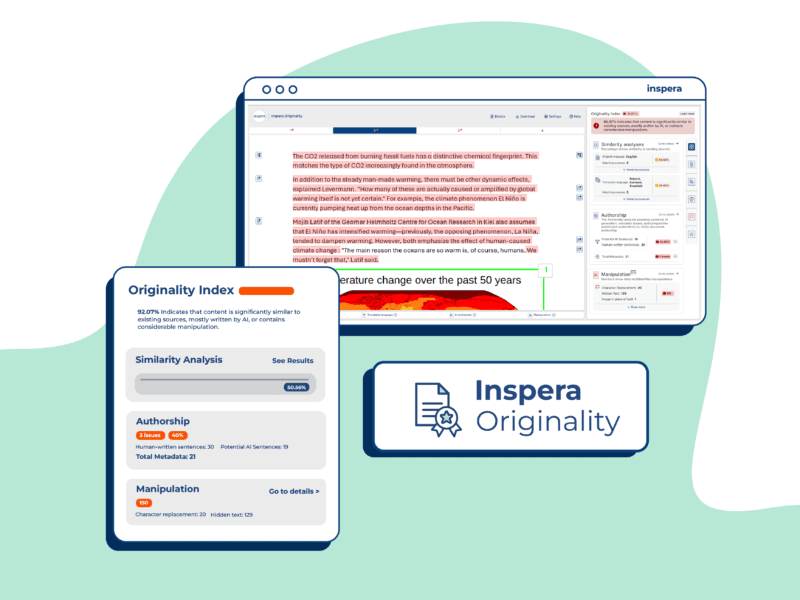
This is where Inspera Originality has been designed from the ground up to be different. We understand that for a tool to be useful, it needs to be accurate all of the time. Inspera has therefore, partnered with Pangram, the most accurate AI prediction tool with the lowest false positive rate on the market, to support 20+ languages and detect all major AI tools including ChatGPT, Claude, Gemini, and other AI writing assistants.
While technological accuracy is a necessary component, it is insufficient to address the complexities of academic integrity. Rather, practitioners must integrate these diagnostic tools within a framework of authentic, holistic assessment strategies designed to preemptively mitigate the incentives for academic dishonesty.

Authentic Assessment
The future of academic integrity lies in developing student skills and assessing authentically.
At Inspera, we believe academic integrity is about learning how to learn. When you write an original essay, you aren’t just filling pages; you’re learning how to absorb that information, engage in critical thinking, and form an independent opinion. Ultimately, Inspera Originality is a learning tool, where students can submit their work and receive feedback on their writing, their citation and their use, or misuse, of AI tools. Bringing transparency to the learning process through a neutral platform of shared learning works to build student confidence, ensuring they can submit without fear of false accusations.
Inspera Originality supports authentic assessment by:
- Supporting real learning – Inspera Originality teaches citation, paraphrasing, and how to develop their own academic voice through feedback in its integrity report.
- Making integrity about more than a number – Inspera Originality is not about chasing a percentage. What really matters is the type of matches found: references, quotes, or poor paraphrasing, but all power remains in the hands of educators.
- Building trust, not fear – The goal of Inspera Originality is to help students learn and give educators meaningful insights, not to punish them.
Creating a portfolio of submissions – Students can submit their in-progress projects, allowing educators to track their learning journey, provide feedback, and gain a deeper insight into student progression.
A New Approach to Originality
Ultimately, the goal is to transform integrity reports from scorecards of suspicion into maps for learning. By combining robust technology with authentic assessment design, we move beyond trying to catch misconduct at the cost of the student experience. Educators can foster a culture where integrity is a standard of excellence that students are proud to uphold, protecting both the institution’s credibility and the learner’s intellectual journey.
About Inspera Originality
Inspera Originality is an academic support tool that promotes integrity by offering meaningful, context-aware feedback throughout the learning, teaching and assessment journey. It uses advanced techniques to help students improve their writing to foster trust and further learning, rather than just being used as a post assessment tool.