AI Content Prediction – Powered by Pangram


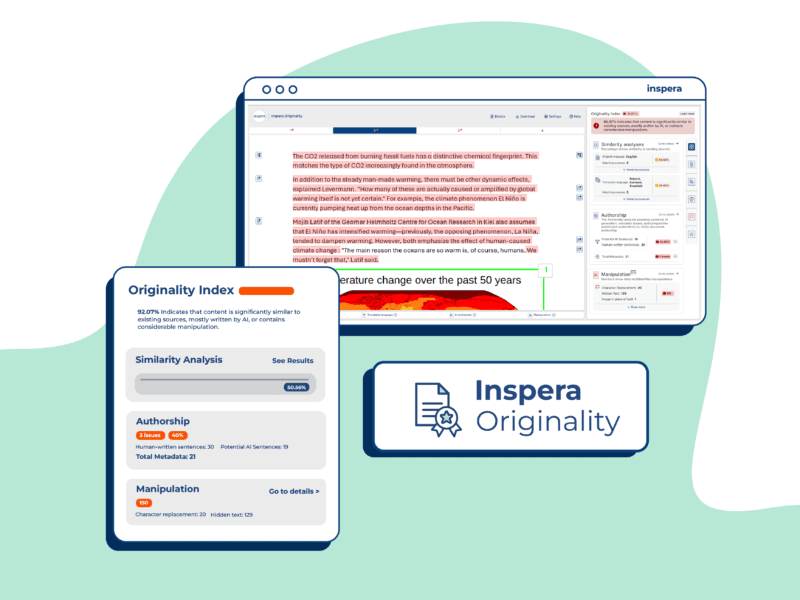
AI Content Prediction in Inspera Originality provides additional insight into how a text may have been produced. It helps educators review submissions where AI tools may have been used, by highlighting patterns in the writing and surfacing relevant indicators.
This is not a standalone “AI detector”. It is part of a broader originality view, alongside similarity, text manipulation insights, and contextual analysis.
What you see in the report
When AI Content Prediction is enabled, the originality report includes:
- AI score and human score – Indicators that reflect the model’s assessment of likely AI involvement and likely human authorship
- AI confidence – An indication of how confident the model is in its assessment
- Flagged segments – Specific parts of the text that may require closer review
These elements are designed to guide attention, not to provide final answers.
What the AI indicators mean
The AI score represents the model’s estimate of how much of the text may have been AI-generated or AI-assisted. It reflects patterns across the document, rather than a precise measurement.
The human score provides a complementary indication of likely human authorship.
Together with flagged segments and confidence levels, these indicators are intended to support review, not replace it.
How the AI insights are generated
AI Content Prediction in Inspera Originality is powered by Pangram.
The model analyses the text in sections and looks at writing patterns such as:
- structure and variation
- word choice
- linguistic consistency
Based on this, it estimates the likelihood of AI involvement across different parts of the document.
Pangram reports a very low false positive rate of 1 in 10,000 in its testing. As with all AI-based systems, results should still be reviewed in context.
Pangram’s approach has also been evaluated in collaboration with independent academic researchers and tested on large and diverse datasets of both human and AI-generated writing. This provides a strong foundation for the model’s performance, but does not remove the need for careful human interpretation in practice.
Within Inspera Originality, these AI insights are presented alongside other analytical perspectives, including contextual similarity, metadata analysis, and proximity indicators. Together, these provide a broader understanding of how a submission has been produced, helping educators interpret patterns in context rather than relying on a single score or percentage.
How to interpret the results in practice
The indicators in the report should be understood as signals, not conclusions.
In practice, a document flagged for AI does not necessarily mean it was entirely generated by AI.
Many submissions today reflect hybrid writing processes, for example:
- a student starting with an AI-generated draft and editing it
- a student writing their own text and using AI tools to expand or refine it
The AI score, flagged segments, and confidence levels help identify where further review may be needed.
They should always be interpreted in context:
- the nature of the assignment
- the level of the student
- expected use of tools
- institutional policy
There is no single number or highlight that determines misconduct.
What this feature does – and does not do
AI Content Prediction helps you:
- identify patterns that may indicate AI-assisted writing
- focus your review on specific parts of a submission
- support informed, evidence-based academic conversations
It does not:
- determine whether misconduct has occurred
- replace academic judgement
- provide definitive proof of AI use
The responsibility for interpretation always remains with the educator and the institution.
How this differs from similarity analysis
Similarity and AI Content Prediction answer different questions.
- Similarity analysis looks for matches between the submission and existing sources
- AI Content Prediction looks at how the text itself is written
They are complementary, but independent. A low similarity score does not mean the text is original in authorship. A high AI score does not mean content is plagiarised.
Important limitations
Like all AI-based systems, this capability has limitations.
- Predictions are probabilistic, not definitive
- Short or highly structured texts can be harder to assess reliably
- Some types of writing may resemble AI-generated patterns without being AI-generated
- AI tools and writing practices continue to evolve
For these reasons, results should always be reviewed carefully and never used in isolation.
Recommended use in practice
AI Content Prediction is most valuable when used as part of a broader review process.
A typical approach would be:
- review the overall indicators
- look at flagged segments in context
- consider the assignment design and expectations
- follow up with the student if needed
The goal is not detection for its own sake, but to support fair, transparent, and educationally meaningful conversations.
A note on academic integrity
Technology alone will never solve academic integrity challenges.
But when it is aligned with educational values, it can support the conversations that matter most between educators and students.