Redefining Assessment Pathways: How Inspera Empowers Lane 1 and Lane 2 Assessment Delivery


As higher education transitions toward flexible and diverse frameworks, universities require ecosystems capable of protecting academic integrity in high-stakes environments while enabling authentic, continuous learning. Driven by a collective push to expand the scope of curriculum delivery and assessment, institutions are moving away from monolithic, one-size-fits-all testing models. Instead, universities are increasingly adopting distinct frameworks such as the Lane 1 and Lane 2 approach to assessment pioneered by The University of Sydney.
Understanding the Two-Lane Assessment Strategy
The distinction between Lane 1 and Lane 2 represents a strategic division in education between security and output.
Lane 1 (Controlled Assessment): Lane 1 assessments are conducted under highly secure, supervised, or invigilated conditions. Their primary purpose is to provide institutional assurance and definitive proof of a student’s individual capability, meaning that the use of generative AI tools is restricted by default unless explicitly permitted for a specific task.
Lane 2 (Open Assessment): Lane 2 assessments are flexible, learning-oriented tasks, such as portfolios, essays, or artifacts. These assessments are often directly vocational and completed under open, unsupervised conditions. Their primary purpose is to foster developmental learning, student ownership, and critical thinking, meaning that students are actively permitted to use generative AI tools without restriction to support their work.
To successfully scale these parallel assessment tracks, institutions require a unified digital ecosystem. Inspera’s end-to-end platform directly answers this need, providing the flexible question types, robust security layers, and data-driven grading workflows required to deliver both Lane 1 and Lane 2 assessments seamlessly at scale.
Driving Transformation: Inspera’s Unified Solution
Inspera’s unified ecosystem eliminates the friction of navigating separate platforms for different assessment formats. By consolidating authoring, delivery, proctoring, and grading into a single ecosystem, the platform allows universities to execute a cohesive two-lane assessment strategy from one dashboard.
Delivering for Lane 1: Security of Assessment
For high-stakes Lane 1 assessments, Inspera ensures comprehensive exam security, rigorous identity verification, and sophisticated monitoring tools designed to safeguard institutional standards.

Inspera Integrity Browser (Locked Environment)
For summative testing, Inspera Integrity Browser is an advanced security feature that locks down the student’s device. It prevents the opening of unauthorised browser tabs, disables copy-paste functions, restricts keyboard shortcuts, and blocks unpermitted applications, ensuring total control over the assessment environment.
Screen Recording
Inspera Proctoring provides flexible monitoring tailored to an institution’s specific definition of integrity. One of these options is the ability to record a student’s screen to ensure integrity.
Inspera Originality in the AI Era
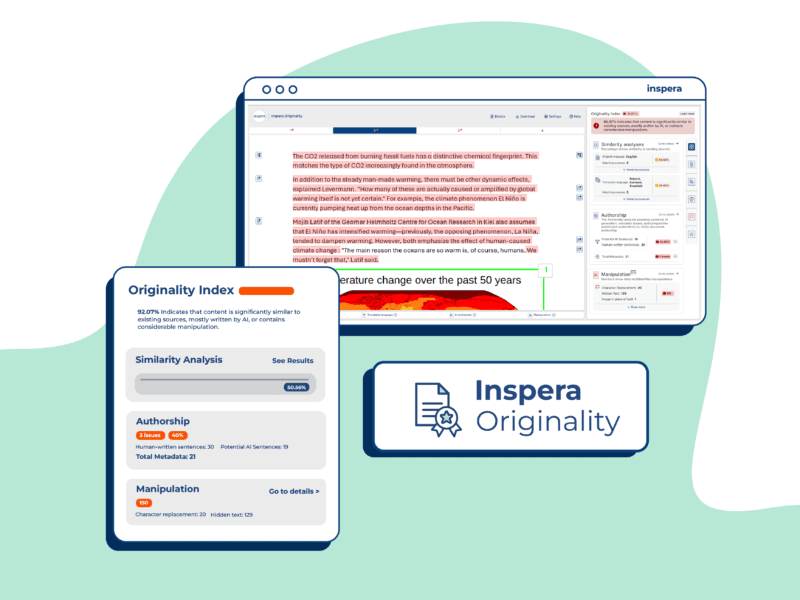
As institutions face mounting challenges surrounding plagiarism and unauthorised AI usage, Inspera Originality provides integrated analysis within Inspera Assessment. Fully embedded within the grading workflow, it gives evaluators actionable insights into both traditional plagiarism and AI-generated content, blending detection tools with educator judgement, allowing faculty to make high-stakes academic decisions with confidence.
Offline Resilience
Exam day disruptions can severely compromise student performance and exam security. Inspera’s industry-leading offline resilience ensures that if a campus network fails during a high-stakes exam, the assessment and background proctoring continue functioning smoothly without data loss, uploading the encrypted data automatically once connectivity is restored.
Delivering for Lane 2: Reinforcing the Path to the Final Result
Because Lane 2 assessments emphasise continuous growth, the Inspera platform prioritises flexibility, diverse question types, and streamlined feedback loops to support ongoing learning, with or without a restricted environment, allowing educators to create varied vocational and authentic assessments.
Diverse and Advanced Question Types
Inspera offers a rich repository of automated and open-ended question types. For STEM and business disciplines, this includes specialised programming code compilation modules and integrated spreadsheet components, allowing students to tackle authentic, real-world problems rather than generic multiple-choice questions.
Automated and AI-Assisted Feedback
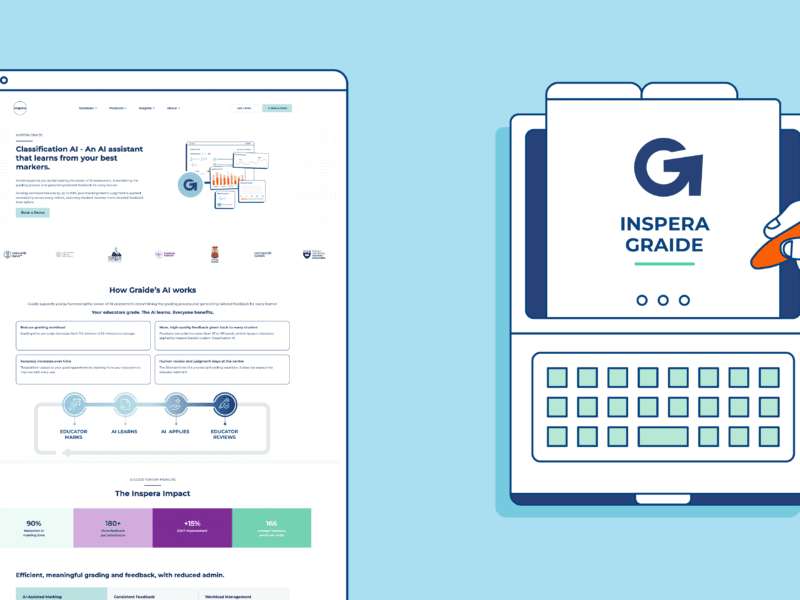
To reduce the grading burden associated with continuous assessment, Inspera incorporates advanced workflows and tools like Inspera Graide. This capability utilises classification AI to streamline the evaluation of open-ended and mathematical responses, enabling faculty to deliver personalised feedback rapidly when it matters most to the student.
Accessible, Anywhere Delivery
Lane 2 tasks can be completed asynchronously from any location, maximising student-centric flexibility and engagement while maintaining varied security standards. Institutions are able to deliver both Lane 1 and Lane 2 assessments with flexibility at scale with Inspera’s Bring-your-own-device functionality.
A Shared Vision for Modern Higher Education
Transitioning to a robust Lane 1 and Lane 2 model is more than a technological upgrade – it is an institutional commitment to learning outcomes, academic excellence, and long-term innovation.
By anchoring both pathways within Inspera’s complete assessment ecosystem, forward-thinking universities are creating a repository of building blocks within Inspera’s Item Banks that can be used for future assessments.
Learn More
Discover how global higher education institutions leverage Inspera to deliver secure, scalable digital assessments across every stage of the student journey:
Two Lane Assessment
An assurance task is a supervised, controlled assessment designed to verify an individual student’s capability with confidence. In the Lane 1 model, assurance tasks give institutions definitive proof that a student has met a required standard, which is why generative AI tools are restricted by default unless an assessment explicitly permits their use.
Not every learning outcome requires a controlled assurance task. Institutions typically reserve Lane 1 for outcomes that need individual, verifiable proof of capability, while Lane 2 formats are better suited to outcomes built around applied skills, creativity or collaboration. Mapping outcomes to the right lane helps institutions avoid over-testing while still meeting assurance requirements where they matter most.
Lane 2 assessment is most closely aligned with the principle of assessment for learning. Because it prioritises ongoing feedback, student ownership and iterative improvement over one-off proof of performance, it supports the kind of continuous development that assessment for learning is designed to encourage.