Assessment for Learning in STEM Disciplines: How the University of Auckland Uses Formative Quizzes in Inspera to Prepare Students for Final Exams


The University of Auckland implemented Inspera’s digital assessment platform during COVID-19 lockdowns in New Zealand. Primarily used for online exams and tests, the platform’s potential has further been expanded by Dr. Hazim Namik from the Mechanical and Mechatronics Engineering department. He created formative quizzes for engineering students using numerical simulation questions, providing them with opportunities for practice and feedback before final assessments. Today, this capability has evolved assessment practices for engineering students beyond summative testing into assessment for learning, with rich feedback, that supports students’ development of knowledge and skills.
The Challenge: Developing Multistep Thinking
Engineering demands a particular kind of analytical mind. Students arriving from high school are accustomed to single-step solutions: read the question, pick a formula, plug in numbers, and the answer appears. But engineering problems don’t work that way. They require multistep processes where solutions unfold through careful sequences of calculations and decisions. By providing students with authentic engineering problems, they have the advantage of improving their analytical thinking, whilst ensuring they evaluate the context and the processes of application to develop a deeper understanding of how their skills apply within the wider world.
“We wanted a tool that will help develop this thinking in students, that the answer is multistep, and they have to start thinking that way,” explains Dr. Namik. “And of course, practice makes perfect, so we wanted a practice and assessment tool that scales well with the number of students we have, and for them to get immediate feedback. So, it had to be automatically marked as well.”
The requirements were clear. Engineering students need practice assessments that:
- Break down complex problems into logical steps, mirroring how engineers actually solve problems.
- Facilitate spaced repetition so students encounter topics through multiple delivery methods – lecture introduction, tutorial practice, fortnightly quizzes, and exams, embedding knowledge for professional practice.
- Provide a low-stakes practice environment where they can safely apply their learning, and self-efficacy before high-stakes assessments.
- Provide multiple answer points throughout a solution, not just at the end.
- Give partial credit for demonstrating correct methodology, even when arithmetic errors occur.
- Provide immediate, human-drafted multistep feedback that helps students understand the process so they can learn from mistakes while the problem is fresh.
- Scale effectively to handle hundreds or thousands of students.
Traditional written examinations requiring manual marking were adequate for summative assessment; however, within this practice-based context they failed to provide the timely feedback cycles necessary for meaningful learning. Moreover, existing automated assessment tools frequently constrained questions to formats involving single response fields and binary scoring, offering either full credit or none, thereby limiting their pedagogical effectiveness.
Academic integrity presented another consideration. Rather than implementing measures like lockdown browsers, the team took a more balanced approach: multiple question banks and randomisation within questions made it more difficult for students to copy from one another while preserving the assessment as a learning experience and avoiding restrictive or overly punitive measures.
The Real Shift: Numerical Simulation Questions
In early 2024, Dr. Namik discovered that Inspera was developing numerical simulation questions. He joined the beta trial, provided feedback to the product team, and by mid-2024 ran it in a live course: MECHENG 222, a second-year dynamics course with 260 students.
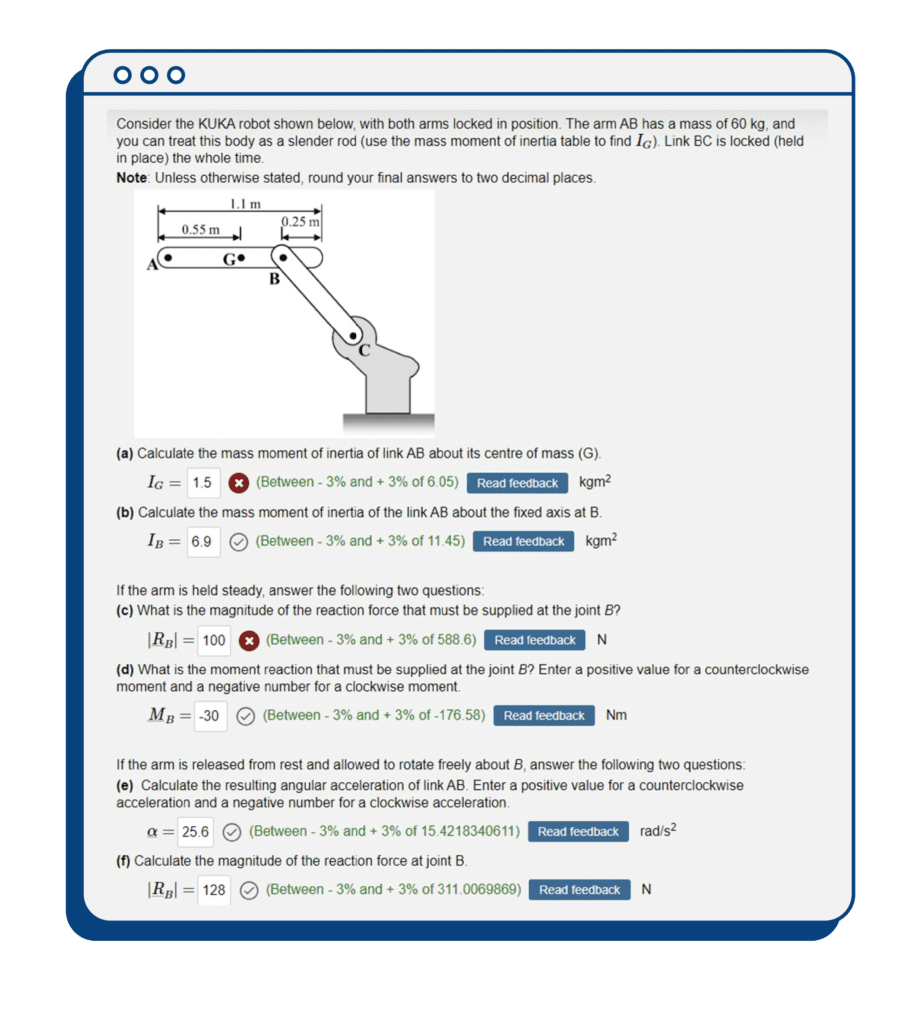
The difference was transformative. Instead of one answer box, academics could now embed multiple response fields throughout a problem, guiding students through each stage of the solution process. Questions could include text before and after answer boxes, creating a natural flow that mirrored how engineers actually solve problems.
But the real innovation was error carried forward (ECF) functionality.
The Game-Changer: Learning from Mistakes
Imagine working through a six-part engineering problem. You copy one number incorrectly early on and carry that error through your calculations. Under traditional binary marking, you’d receive zero points despite demonstrating perfect understanding of the methodology.
With ECF, the system checks whether your process is correct based on your previous answers, even if those answers contain errors. “This helps the student identify mistakes rather than just telling them everything is wrong with no indication where they went wrong,” Dr. Namik notes. “From a student’s learning point of view, it’s incredibly valuable.” Instead of discouraging students with zeros that don’t reflect their actual understanding, ECF provides a nuanced picture of where learning is solid and where it needs reinforcement.
Beyond error carry forward, there’s another powerful feature: tailored feedback for every single answer box. Students don’t just see “incorrect”, they receive specific guidance based on common mistakes, helping them understand exactly where their thinking went wrong.
Real-World Implementation
After the successful pilot in MECHENG 222, Dr. Namik expanded to ENGGEN 121 in 2025, a first-year mechanics course with 1,024 students. The quizzes were structured to encourage spaced repetition: concepts introduced in lectures, practiced in tutorials, reinforced through fortnightly quizzes, then tested and examined.
Students received:
- Fortnightly quizzes worth 15% of final marks
- Three attempts. Each attempt was limited to 60 minutes
- Questions pulled from randomised question banks to maintain academic integrity
- Partial credit through multiple answer boxes
- ECF to reward correct methodology despite calculation errors
The system wasn’t just about assessment; it was about learning. Students had access to practice quizzes with unlimited attempts and time to familiarise themselves with the platform before graded assessments began.
The Results Speak for Themselves
The statistics told a compelling story. By 2024, using Inspera numerical simulation questions, both participation and achievement increased noticeably. While Dr. Namik acknowledges the improvement could stem from multiple factors, the trend was undeniably positive.
But the most powerful evidence came from students themselves:
“Having multiple parts to each question was particularly helpful as it naturally guided me through the problem-solving process, which improved both my understanding and confidence in tackling the material.”
“The fortnightly quizzes were possibly the most helpful tool for learning apart from the tests. They really helped me understand the content covered in the weeks before.”
The Broader Impact
This story extends beyond one university or one engineering department. It demonstrates how thoughtful integration of assessment technology can transform the learning experience, particularly in disciplines requiring complex, multistep problem-solving.
The key isn’t just adopting new tools, it’s reimagining assessment as a learning opportunity rather than merely a measurement exercise, and repositioning assessment as a student-centric practice. By providing immediate feedback, partial credit for correct methodology, and multiple opportunities to practice, institutions can create environments where students genuinely develop the analytical thinking their professions demand.
Looking Forward
As numerical simulation questions continue evolving, Dr. Namik sees opportunities for giving students even greater agency in their learning, moving beyond marks as the primary motivator. The challenge remains finding the right balance between quiz complexity, time investment, and learning outcomes.
But the fundamental shift has already occurred. At the University of Auckland, assessment has evolved from a binary judgment into a nuanced conversation about learning-one multistep problem at a time.